
That cracked concrete driveway’s been bugging you for years, hasn’t it? Every time you pull in after work, there it is – another reminder of the projects you keep meaning to tackle. And when neighbours walk past or friends visit, you know they’re seeing it too. The thing is, your driveway’s doing more than just embarrassing you. On the Central Coast, where properties are worth serious money, a tired old driveway can actually cost you when it comes time to sell.
Here’s what most people don’t realise about driveway paving – it’s not just about making your place look better from the street. Yeah, that’s part of it, and honestly it’s a big part. But a properly paved driveway handles our coastal conditions way better than that old concrete slab that’s probably been there since the ’90s. Salt air, heavy rain, vehicles turning and reversing – all of that takes its toll over time.
We’ve been installing quality paved driveways across Terrigal, Avoca, Wamberal and surrounding Central Coast areas for years. The transformations we see are pretty incredible – not just in how the property looks, but in what it does for homeowners. Suddenly you’re not dodging that same pothole every morning. Your property value gets a genuine boost. And when you’ve got visitors coming over, the driveway’s actually something you’re proud of instead of something you apologise for.
Let’s talk about what goes into a driveway that’ll actually last on the Central Coast, and more importantly, what your options are.
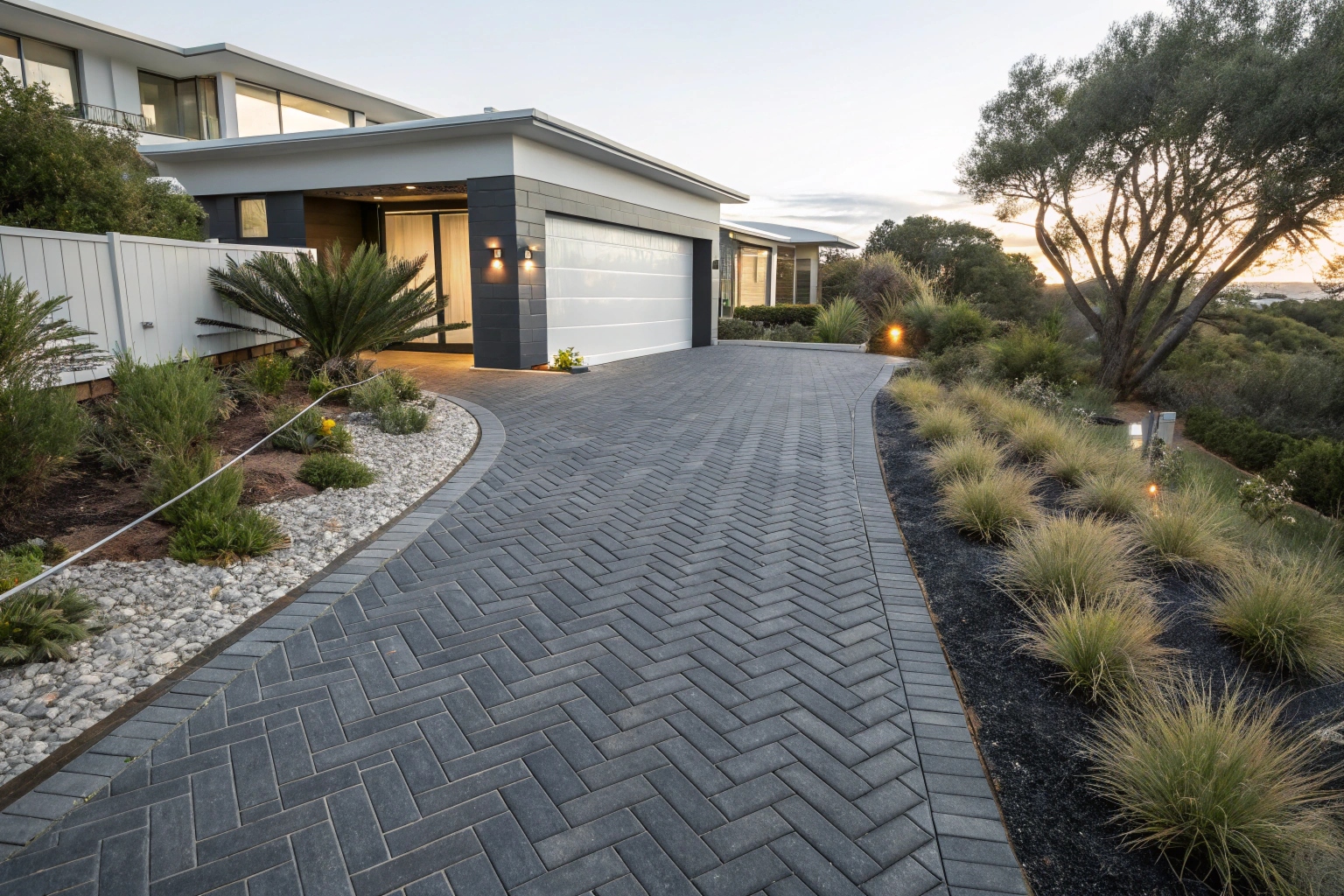
Choosing the Right Pavers for Your Central Coast Driveway
So you’ve decided to get the driveway done properly – now comes the fun part, and honestly, the part where most people get a bit overwhelmed. Walk into any paving supplier and you’ll see hundreds of options staring back at you.
Concrete pavers are probably what you’ll see on most Central Coast driveways, and there’s good reasons for that. They’re tough, they come in pretty much any colour you can think of, and they handle our climate well. You’re looking at something that’ll last 25-30 years if it’s laid right. Price-wise, they’re the most budget-friendly option that still gives you that quality look.
Then you’ve got clay bricks – the classic choice that never really goes out of style. They’ve got this warmth to them that concrete can’t quite match, and they actually get better looking as they age instead of worse. Salt air doesn’t bother them at all. Bit more expensive than concrete, but a lot of people reckon they’re worth it.
Interlocking pavers are brilliant because they lock together like puzzle pieces. That means they can handle movement better – and trust me, with Central Coast’s sandy soil, you want pavers that can move a bit without cracking. Perfect for driveways that cop a lot of turning from heavy vehicles.
For something really special, granite sets or cobblestones give you that high-end European look. They’re not cheap, and they take longer to install, but if you’re going for serious street appeal they’re hard to beat. We usually see these on feature driveways or as borders combined with other materials.
The paver you choose needs to suit how you actually use your driveway, not just how it looks in the brochure.
Why the Foundation Matters More Than the Pavers You Pick
Here’s something that’ll save you thousands down the track – the pavers you see on top? They’re actually the easy part. What’s underneath is where good driveway companies separate themselves from the cowboys.
We see it all the time on the Central Coast. Someone paid good money for beautiful pavers, but eighteen months later they’re sinking in spots, gaps are opening up, and weeds are pushing through. Nine times out of ten, it’s because whoever laid it skipped steps on the base preparation.
A proper driveway base on the Central Coast needs to go deep – we’re talking 150-200mm of compacted road base minimum, sometimes more depending on your soil and what vehicles you’re parking. That sandy coastal soil shifts around, especially when we get those heavy downpours. Without a solid base that’s been compacted properly in layers, you’re basically just putting expensive pavers on top of sand and hoping for the best.
The excavation has to account for drainage too. Water’s got to go somewhere, and if it’s sitting under your pavers, that’s when you start getting problems. We install drainage layers under the road base – sometimes using blue metal screenings, sometimes specialised drainage cell systems if your block’s particularly flat or prone to water pooling.
Your mate might’ve told you he laid his driveway in a weekend. That’s the problem right there. Proper compaction takes time. Each layer needs to be done right, given time to settle, checked for levels. Cut corners here and you’ll be paying to redo the whole thing in five years instead of enjoying it for thirty.
Design Options That Actually Work for Your Property
So you’ve got the basics sorted – now let’s talk about making your driveway look good, because that’s half the point, isn’t it?
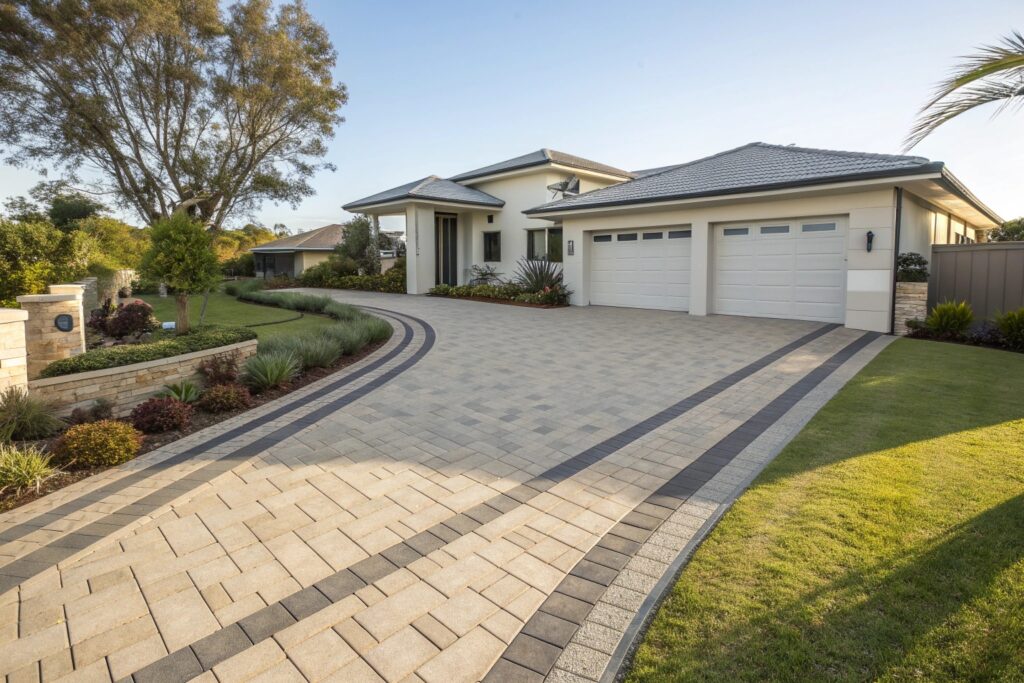
Colours and patterns are where you can really make a statement or keep things subtle, whatever suits your place. A lot of Central Coast homes go with charcoal or sandstone tones – they hide dirt better than lighter colours and they complement most house styles. But if you’ve got a coastal Hampton’s vibe going on, those lighter pavers with darker borders can look absolutely stunning.
Pattern-wise, herringbone’s the most popular for driveways because it locks together so well and it handles turning vehicles without pavers shifting. Stretcher bond (the brick-laying pattern) works great too and it’s a bit simpler, which can bring costs down slightly. Some people go for basket weave or circular patterns in feature areas, but honestly those are better for courtyards than driveways that cop heavy use.
Here’s where people often get caught out – driveway width. Standard single-car width is about 3 metres, but if you’ve got an SUV or ute, you want to be looking at 3.5 metres minimum. Trying to squeeze a big vehicle down a narrow driveway gets old fast, especially when you’re unloading shopping or kids.
If you’re doing double-width, 5.5 to 6 metres gives you room for two cars plus opening doors without scratching paint on garden beds. And if you’ve got a trailer or boat, factor that in now – adding width later means ripping up garden beds or fences you’ve already paid for.
Feature strips between tyre tracks using contrasting pavers add visual interest without going overboard. Border edging in different colours defines the driveway edges nicely and stops it bleeding into the lawn.
Drainage Solutions That Protect Your Investment
Alright, this bit’s not glamorous but it’s absolutely critical on the Central Coast. Get the drainage wrong and you’ll have water running into your garage, pooling on the driveway, or worse – heading straight for your house foundations.
Crossfall is the first thing we sort out – that’s the slight slope across your driveway that moves water off to the sides. Usually about 2-3%, which you won’t even notice when you’re walking on it, but it makes all the difference when it’s bucketing down. Water needs to know where it’s going, and it can’t be towards your house.
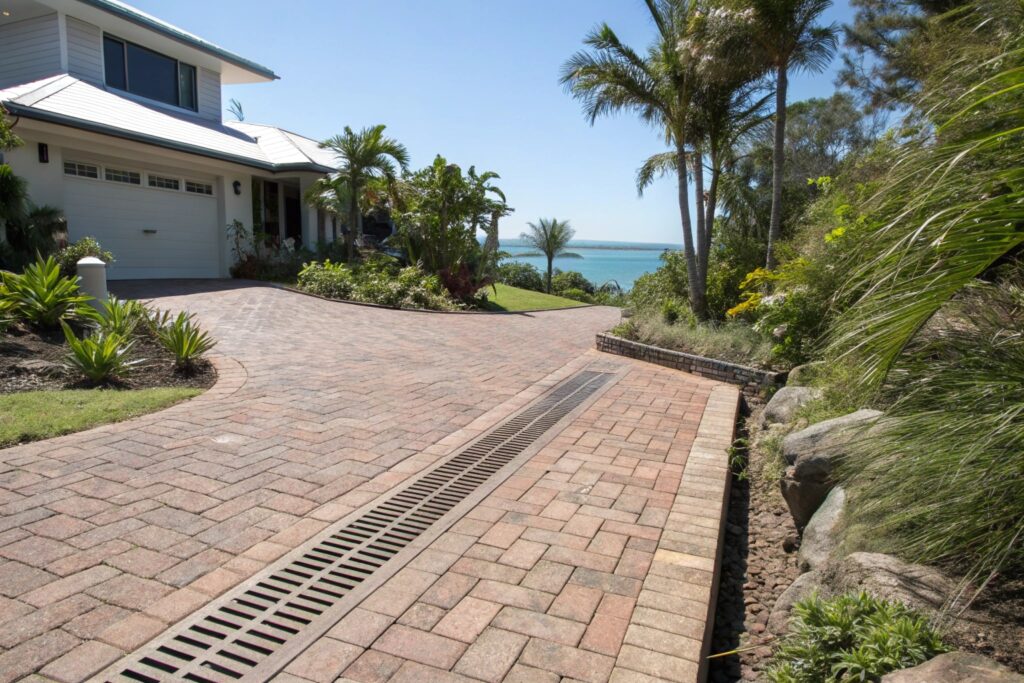
For driveways that run uphill to the garage or have flat spots, channel drains are your best friend. These sit across the driveway and catch water before it can get to your garage door. We see a lot of properties where the previous owner didn’t install one and now they’re dealing with water damage in the garage every time it rains heavily.
Permeable pavers are worth considering if you’ve got concerns about stormwater runoff. They let water drain through the surface instead of running off into the street. Council’s getting stricter about stormwater management, and in some areas they’re pretty much requiring it for new driveways. Plus they help prevent those big puddles that hang around for days after rain.
The thing about drainage is you don’t notice it when it’s done right – you only notice when it’s done wrong and you’re dealing with problems. Spend the money here. It’s way cheaper than fixing water damage later.
Edging, Borders and Finishing Touches
The edges of your driveway are where a lot of DIY jobs fall apart, and honestly where you can tell if a professional’s done the work or not. Pavers need something solid holding them in place, otherwise they start creeping outward over time and the whole thing loses its shape.
Soldier courses – that’s pavers laid perpendicular to the main pattern around the edge – give you a defined border that locks everything in place. They’re functional first, but they also look great, especially if you use a contrasting colour. Charcoal edging around sandstone pavers, or vice versa, really makes the driveway pop.
A lot of Central Coast properties have garden beds running alongside the driveway, and getting that integration right makes a massive difference. You want a clean line between the paving and the gardens – no pavers sinking into garden soil, no mulch spilling onto the driveway. We usually set the paver edge slightly higher than the garden bed level so you can mow or whipper-snip right up against it without hassle.
Concrete edge restraints buried along the perimeter do the heavy lifting – you don’t see them, but they’re what stops the whole driveway from spreading over the years. Some installers skip this step to save time. Don’t let them.
And here’s a coastal-specific thing – with the salt air we get, you want to make sure any metal edging or fixtures are galvanised or stainless steel. Regular steel will rust through within a few years and you’ll have orange stains bleeding into your nice new pavers. Not a good look.
Call us at (07) 4351 4011 or …
What You're Really Investing In (And What It'll Cost)
Let’s talk numbers, because that’s what everyone wants to know but nobody likes to ask straight up. A quality paved driveway on the Central Coast isn’t cheap, but it’s also not as scary as some people think.
Area size is obviously the biggest factor – a standard single-car driveway (about 20-25 square metres) is very different from a double-width driveway with turning area (60-80 square metres). Most properties we work on fall somewhere in between, around 35-50 square metres.
Paver choice makes a big difference too. Concrete pavers might run you $50-80 per square metre installed, while clay bricks or premium granite sets can be $120-180 per square metre or more. That doesn’t include the base preparation, which is usually another $30-50 per square metre depending on how much excavation and drainage work’s needed.
If you’ve got an existing driveway that needs removing first, factor in another $1,500-3,000 depending on what it is and how much hassle it’ll be to break up and haul away. Old concrete’s harder to remove than old pavers, and if there’s any height differences or tricky access, that bumps the price up too.
Here’s the thing though – your property value increase usually covers the cost and then some. Real estate agents on the Central Coast will tell you that a quality driveway can add $15,000-25,000 to your property value, sometimes more on higher-end homes. First impressions count, and the driveway’s literally the first thing people see when they pull up.
Plus you’re getting 25-30 years of use out of it. Work that out per year and suddenly it doesn’t seem like such a big hit to the budget.
Ready to Finally Get That Driveway Sorted?
Look, you’ve probably been thinking about this for a while now. Every time you come home, there’s that reminder staring at you. The good news is getting it done’s easier than you think, and the transformation happens faster than most people expect.
We offer free on-site consultations across the Central Coast – Terrigal, Avoca Beach, Wamberal, Erina, and everywhere in between. We’ll come out, have a look at what you’re working with, talk through your options, and give you a proper quote with no pressure and no rubbish. You’ll know exactly what’s involved, what it’ll cost, and how long it’ll take.
The best time to start a driveway project is during the drier months, but we work year-round and we’re pretty good at scheduling around the weather. Most driveways take 3-5 days from start to finish, and we clean up properly when we’re done – no mess left for you to deal with.
Here’s what happens next – give us a call or shoot through an enquiry and we’ll lock in a time to come see you. We’ll measure up, talk about what you want, show you samples of different pavers, and work out a solution that fits your budget. No obligation, just honest advice from locals who’ve been doing this for years.
Your property deserves a driveway that does it justice. Let’s make it happen.
FAQs About Driveway Paving on the Central Coast
With proper installation and the right materials, you’re looking at 25-30 years minimum. The salt air and coastal conditions don’t phase quality pavers like concrete or clay bricks – they’re actually more durable in our climate than poured concrete, which cracks and deteriorates faster. The key’s in the base preparation. Skip that and even the best pavers won’t last.
Sometimes, but honestly it’s usually not worth it. If your concrete’s cracked or uneven, those problems will telegraph through to the pavers eventually. Most driveways need proper removal and a fresh base. The only time we’d consider paving over existing concrete is if it’s in near-perfect condition, properly graded for drainage, and you’re happy to lose the height difference it creates at your garage door.
Depends on what you’re doing. If you’re just replacing an existing driveway with pavers, usually no approval needed. But if you’re changing the width, adding new vehicle access, or significantly altering drainage, then yeah, you’ll need to lodge with Central Coast Council. We can handle that side of things for you – it’s part of making sure the job’s done right and legal.
Two things – proper base preparation with compacted road base, and using paver joint sand that’s been stabilised or polymeric. That sand hardens between the pavers and stops weed seeds getting a foothold. Some people worry about this constantly but with the right installation you’ll barely see a weed. Quick spray once or twice a year keeps it perfect.
Mid-tone greys and charcoals are your friend here. They hide everyday dirt, tyre marks, and oil spots way better than light colours. If you love the look of lighter pavers, use them as feature strips or borders and go with darker tones in the main traffic areas. Best of both worlds.